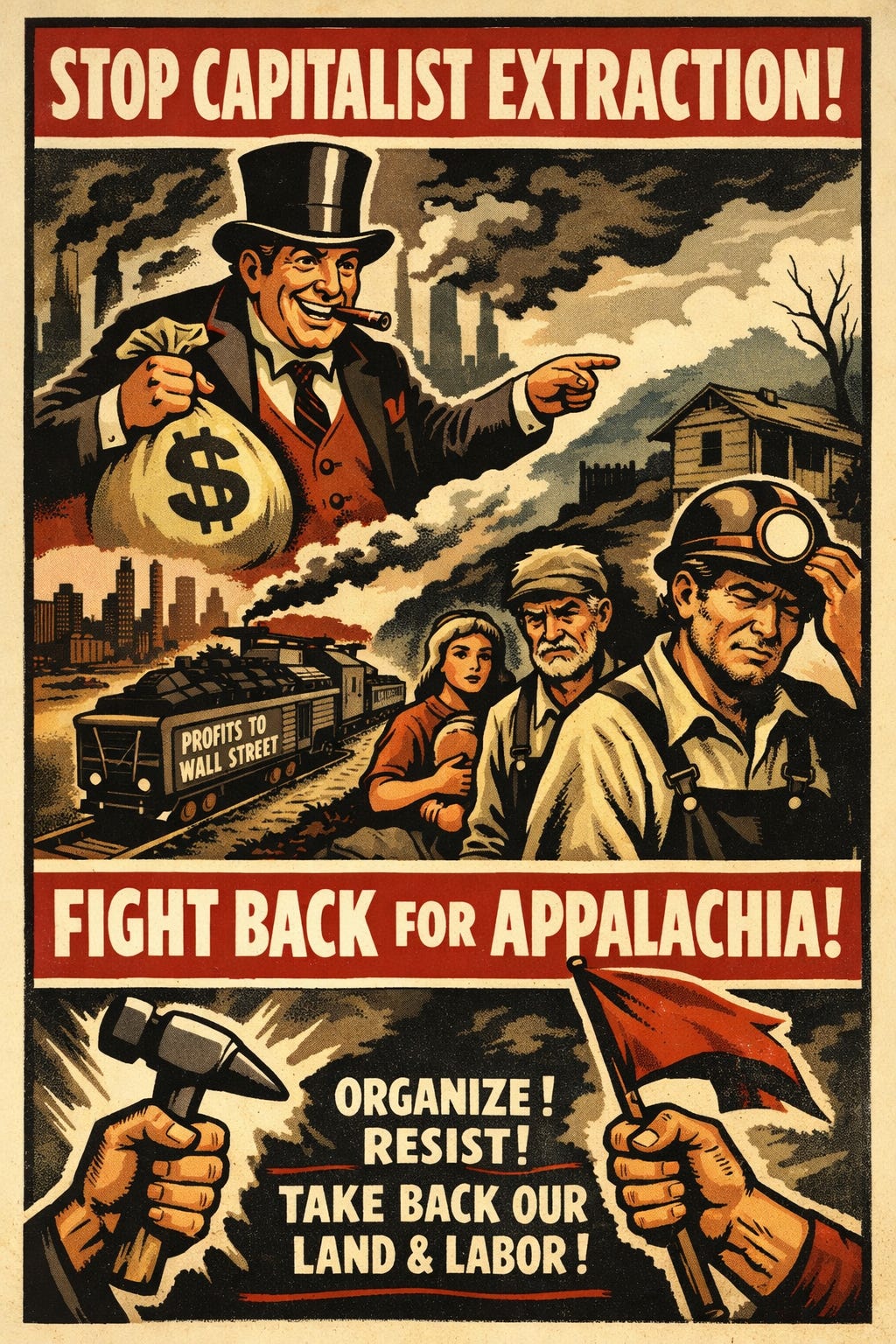
Extractionism, Internal Colonialism, and the Political Economy of Poverty
How Capitalism Plunders Appalachia—and Why It Must Be Stopped

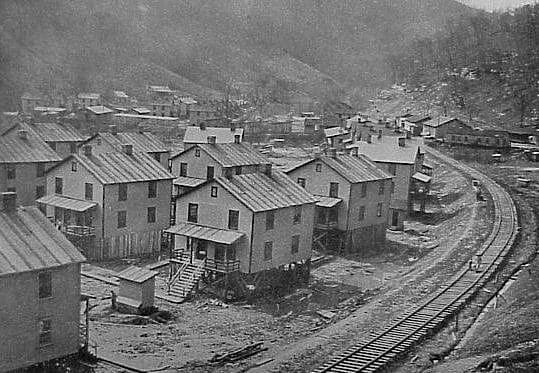
Appalachia can be understood as an internally colonized region within U.S. capitalism, organized to facilitate the extraction of labor power and natural resources for the enrichment of distant capital holders. As Marx demonstrated, capitalism rests on the appropriation of surplus value produced by labor, a process that alienates workers from both the means of production and the wealth they create (Capital, Vol. I). In Appalachia, this alienation is intensified through geographic marginalization, capital flight, and political disempowerment.
Lenin’s analysis of uneven development under monopoly capitalism further clarifies this dynamic. Although often applied internationally, the logic of imperial extraction operates within national borders (Imperialism, the Highest Stage of Capitalism). Appalachia occupies a peripheral position, supplying raw materials and labor to dominant economic centers while receiving little reinvestment, reproducing structural dependency.
Theories of internal colonialism and dependency describe this arrangement with precision. As Andre Gunder Frank argued, “underdevelopment is not due to the absence of development, but to the presence of exploitative relations.” Wealth flows outward, while poverty, environmental destruction, and social dislocation remain localized. These outcomes are not accidental—they are structural.
Kropotkin directly challenged the moral and economic logic underpinning extraction. In The Conquest of Bread, he wrote, “The wealth of the rich is a result of the poverty of the poor,” and argued that capitalism survives by monopolizing resources while denying communities access to the necessities of life. For Kropotkin, deprivation is not a natural condition but a manufactured one, imposed through enclosure, wage labor, and centralized control over production. Appalachia’s experience reflects precisely this process: communities are stripped of land, resources, and autonomy in the name of profit.
Murray Bookchin extended this critique by linking economic exploitation to hierarchical domination and ecological collapse. He warned that capitalism “turns organic nature into inorganic matter, into mere resources to be exploited,” reducing both people and ecosystems to instruments of accumulation. Bookchin emphasized that liberation requires dismantling hierarchical systems of control and replacing them with directly democratic, community-based forms of organization rooted in ecological responsibility and social cooperation.
The concentration of economic power—whether in corporate boardrooms or centralized bureaucracies—undermines genuine democracy and collective self-determination. As Marx insisted, emancipation must be the act of the working class itself. Ending extraction therefore requires more than reform; it requires a rupture with systems that centralize control over labor, land, and resources.
Appalachia’s long history of labor struggle, mutual aid, and resistance positions it as a critical site for transformative change. Wealth must remain where value is produced, governed by workers and communities through collective decision-making. Extractionism is a form of structural violence that reproduces class domination, accelerates ecological devastation, and deepens inequality. Its abolition is not merely desirable—it is necessary for any society organized around human need, ecological balance, and collective freedom.